


Ejendals Introduces Product Environmental Footprints for PPE
At Ejendals, we are committed to increasing transparency and helping organisations make more informed decisions about PPE. We are now introducing Product Environmental Footprints (PEFs) for selected TEGERA gloves, JALAS safety footwear and accessories. As of June 2026, product-level environmental data is available for more than 150 products, and we continue to expand coverage across our product portfolio.
Greater transparency through product-level environmental data
Our vision is zero injuries to hands and feet. As part of our sustainability journey, we are expanding how we measure and communicate the environmental impact of our products.
We are introducing Product Environmental Footprints (PEFs) for selected TEGERA gloves, JALAS safety footwear and accessories. As of June 2026, environmental footprint information is available for more than 150 products, with additional products being added over time. This gives users access to product-level environmental data and greater transparency into the environmental impacts associated with our products.
Explore Environmental Footprint Data
Environmental footprint information is now available for more than 110 products. Explore footprint data directly on individual product pages, such as:
“Product Environmental Footprints and Life Cycle Assessments help us better understand the impact of our products throughout their life cycle and identify opportunities for improvement. We’re adding a layer of transparency and using the data we gather to strengthen our work on eco-design and make safety gear in a responsible way that benefits the customer and the environment.”
– Céline Montanari, Innovation & Sustainability Lead, Ejendals
Based on Life Cycle Assessments
Our environmental footprint calculations are based on Life Cycle Assessments (LCAs), an internationally recognised methodology for evaluating environmental impacts across a product's life cycle.
Our LCA work follows ISO 14040 and ISO 14044, internationally recognised standards for how LCAs are conducted and reported.
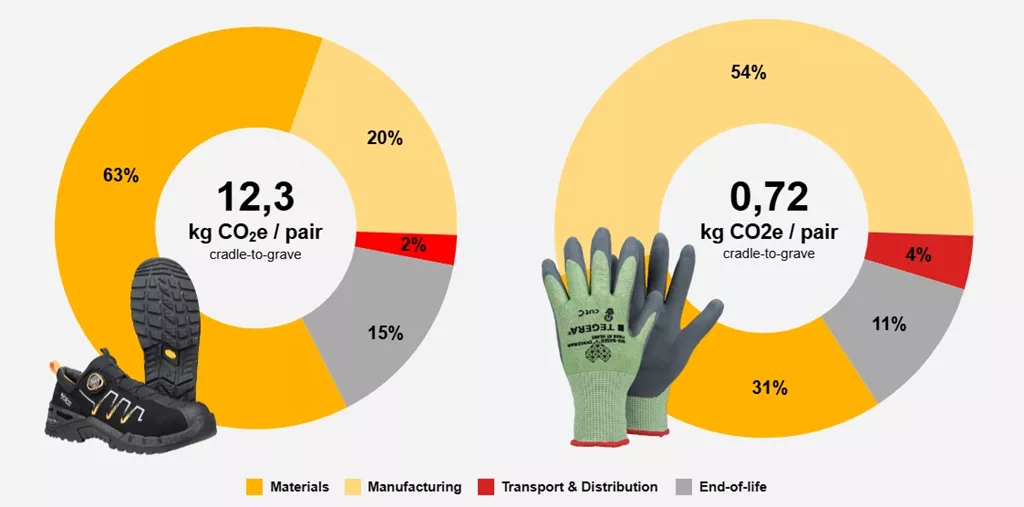
Environmental footprint assessments consider the full product life cycle, from raw material extraction and manufacturing to transport and end-of-life treatment. By performing the analysis in-house, we can apply consistent methodologies, maintain data quality and continuously refine our approach.
The results help us identify where environmental impacts are concentrated and evaluate alternatives in materials, design and production.
Using footprint data to improve products
Environmental footprint assessments are not only used for reporting. The insights also help guide product development and continuous improvement.
The information helps us:
- Evaluate material and design alternatives
- Identify and reduce environmental hotspots
- Integrate environmental considerations into research and development
- Support informed decision-making with reliable product-level data
By integrating environmental insights into our design and development processes, we aim to reduce environmental impact across the value chain without compromising safety, quality, durability or comfort.
Explore Products with Environmental Footprint Data
Environmental footprint data is available directly on selected product pages. The products below are examples of products currently included in our footprint assessments.
3 of 618 products
TEGERA® 9186S
Indicator for vibration exposure
Indicator for monitoring hand-arm vibration. Inner glove TEGERA® 9187 sold separately.
JALAS® TEMPUS 5715
Stylish, lightweight, water-repellent
Eye-catching water-repellent safety shoe with PFAS-free 100% recycled Cordura® re/cor™.
JALAS® TEMPUS 5725
Stylish, lightweight, water-repellent
Lightweight, water-repellent safety shoe with PFAS-free 100% recycled Cordura® re/cor™ and BOA®.
3 of 618 products
Supporting credible environmental information
Environmental footprint results can vary depending on methodology, system boundaries and data sources.
For that reason, we focus on traceable and substantiated information intended to support decision-making. This approach helps us provide credible environmental information while avoiding greenwashing and supporting transparent communication.
As expectations for environmental transparency continue to evolve, access to reliable product-level information becomes increasingly important for organisations seeking greater insight into the environmental impacts associated with PPE products.
Looking ahead
We plan to continue developing our environmental reports over time and sharing additional impact results such as resource use, ecotoxicity, water impacts and circularity as methodologies and data continue to evolve.
This work strengthens our commitment to zero injuries to hands and feet by embedding deeper product knowledge into how we design and improve our products.
It also supports our wider ambition to integrate environmental considerations into our Product Sustainability work alongside safety, durability and comfort, strengthening how we measure, communicate and improve environmental performance.
Learn more
Explore our Environmental Footprint page to learn more about our methodology and how we assess environmental impacts across a product's life cycle.
LIFE CYCLE ASSESSMENTS
Explore Environmental Footprints
Discover how we assess environmental impacts across a product's life cycle, access product-level environmental data and download the Combined Product Environmental Report.
Ejendals Product Environmental Footprint
Download our whitepaper
It explains how we calculate product environmental impact, including what a Life Cycle Assessment is, how Product Environmental Footprints and Product Carbon Footprints are defined, and the methodology we use to assess environmental impact — transparent, precise, and continuously evolving.