


Clasificaciones de resistencia al deslizamiento en el calzado de seguridad
A medida que evolucionan las normas de seguridad, resulta esencial entender su impacto sobre los productos en los que confiamos. Mantuvimos una charla con la experta en conformidad de Ejendals, Sandra Dahlström, para abordar las novedades que incorpora la norma EN ISO 20345:2022 en cuanto a la resistencia al deslizamiento. Aquí están sus conclusiones sobre lo que significan estos cambios para los trabajadores que necesitan una protección fiable en distintas superficies.
Actualizaciones clave en la nueva norma EN ISO 20345:2022
Sandra comenzó explicando que la norma EN ISO 20345:2022 introduce cambios que hacen más fácil entender cómo rinde el calzado de seguridad en diferentes condiciones, particularmente en lo que respecta a la resistencia al deslizamiento y la resistencia a la perforación.
Resistencia a la perforación
La norma especifica tres tipos de marcado, distinguiendo entre opciones con acero y no metálicas:
P: Plantilla de acero testada con un punzón de 4,5 mm de diámetro.
PL: Plantilla no metálica testada también con un punzón de 4,5 mm.
PS: Plantilla no metálica testada con un punzón más pequeño, de 3 mm de diámetro.
Agarre en escaleras de mano
Este ensayo deja ahora de ser obligatorio, lo que ofrece cierta flexibilidad en función del uso previsto para el calzado.
Resistencia al deslizamiento
¿Existe realmente una clasificación “superior a las demás”?
Una de las conclusiones más importantes que Sandra compartió es que no hay una clasificación “superior a las demás” en lo que respecta a la resistencia al deslizamiento. “Desde el punto de vista de la norma, nunca se pretendió crear una jerarquía que distinguiera entre clasificación buena, mejor y la mejor”, explicó Sandra. En realidad, la clasificación a elegir depende mucho de las condiciones específicas del lugar de trabajo.
Anteriormente, la norma EN ISO 20345:2011 clasificaba la resistencia al deslizamiento en tres categorías:
SRA: Ensayo realizado en un suelo de cerámica con una solución jabonosa.
SRB: Ensayo realizado en un suelo de acero con glicerina.
SRC: Calzado que cumplió los criterios tanto de SRA como de SRB.
Sandra Dahlström
Product Compliance Manager at Ejendals
Discover More about EN ISO 20345:2022
Want to know what else is new in the EN ISO 20345:2022 standard? Find out here.
Under this older standard, SRC might seem like the “best” option, but as Sandra points out, it’s more complex than that.
“An outsole that excels in SRA conditions might not be as effective in SRB conditions, and vice versa. To meet both requirements, some compromises might be made in the design, so SRC approval doesn’t necessarily mean the highest slip resistance in every environment.”
What’s New in EN ISO 20345:2022?
The new 2022 standard has eliminated the SRA, SRB, and SRC classifications to avoid confusion. Instead, slip resistance testing is now a basic requirement, meaning all safety footwear must be tested on ceramic floors with soap solutions without needing a specific marking. However, there is an optional SR test, indicating that the footwear has been tested on a ceramic floor with glycerin, suited for more oily surfaces.
- Mandatory Test (no marking) - Conducted on ceramic floors with soap solution.
- Optional SR Test - Conducted on ceramic floors with glycerin, designed to evaluate the footwear’s performance on oily surfaces.
By incorporating slip resistance as a baseline requirement, the updated standard emphasizes that all certified safety shoes meet a minimum threshold without labeling, making the selection process more straightforward.

Real-World Application: Testing Beyond the Laboratory
Sandra emphasized that while lab-tested slip resistance ratings are helpful, they don’t account for the diverse and unpredictable conditions workers may encounter. “No set of laboratory tests can fully model the wide range of real-life walking surfaces,” she noted. This is why Sandra recommends conducting footwear field trials in the actual workplace environment to assess performance accurately.
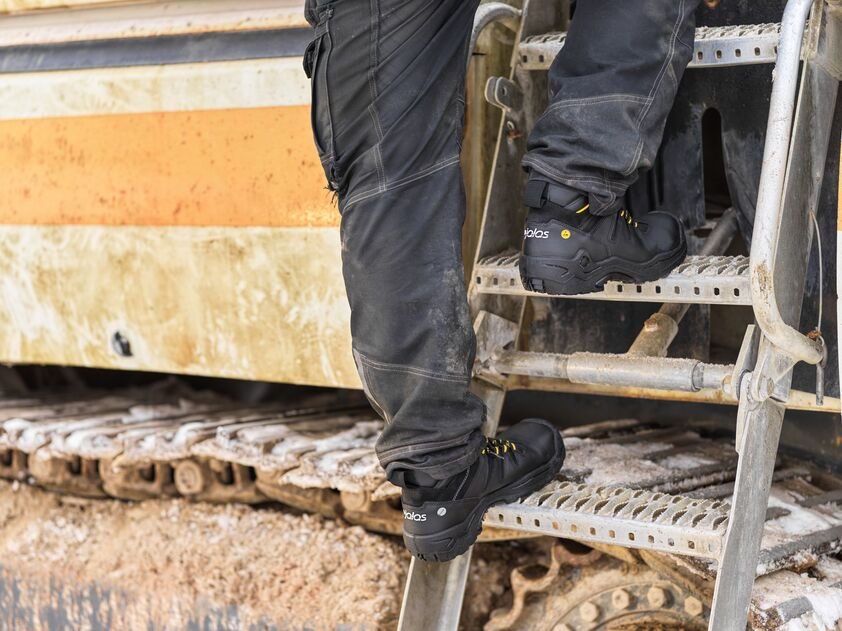
A slip-resistant outsole reduces, but doesn’t eliminate, the risk of slipping.
“It’s essential to remember that these ratings indicate potential performance; they aren’t a guarantee. Testing the shoes in the environment where they will be used provides a clearer picture of suitability.”
Conclusion: Choosing the Right Footwear for Your Environment
The EN ISO 20345:2022 update reflects a more holistic approach to safety standards, eliminating the misconception of a “best” slip resistance rating and promoting a focus on the actual needs of the workplace. With slip resistance now a foundational requirement, workers and employers can select footwear with confidence while understanding that some conditions may still require additional trials.
Sandra’s final advice?
“Stay proactive in safety equipment choices. Opt for shoes with slip resistance ratings that align with your specific work environment and, whenever possible, test them on-site to ensure they provide the protection you need.”

Discover JALAS®
JALAS® Work & Safety Shoes are engineered for the ultimate in slip resistance, comfort, and protection. Since 1916, JALAS® has upheld a commitment to quality, with all products designed, developed, and crafted in Jokipii, Finland. Discover our range of safety shoes, boots, and sandals—each built to keep you safe on the job without compromising comfort.