


Notes de résistance au glissement dans les chaussures de sécurité
À mesure que les normes de sécurité évoluent, il est essentiel de comprendre leur impact sur les produits sur lesquels nous nous appuyons. Nous avons discuté avec l’experte en conformité d’Ejendals, Sandra Dahlström, des dernières mises à jour des normes de résistance au glissement dans la réglementation EN ISO 20345:2022. Voici son point de vue sur ce que ces changements signifient pour les travailleurs à la recherche d’une protection fiable sur diverses surfaces.
Principales mises à jour de la nouvelle norme EN ISO 20345:2022
Sandra a commencé par expliquer que la norme EN ISO 20345:2022 introduit des changements qui facilitent la compréhension des performances des chaussures de sécurité dans différentes conditions, en particulier en matière de résistance au glissement et de protection antiperforation.
Résistance à la perforation des clous
La norme spécifie trois types de marquages, en distinguant les options en acier des options non métalliques :
P : insert en acier avec un clou d'essai de 4,5 mm de diamètre.
PL : insert non métallique, également testé avec un clou de 4,5 mm.
PS : insert non métallique testé avec un clou plus petit de 3 mm de diamètre.
Adhérence à l’échelle
Il s’agit désormais d’un test non obligatoire, qui permet une certaine flexibilité en fonction de l’utilisation prévue des chaussures.
Adhérence au sol
Existe-t-il vraiment une note « maximale » ?
L’une des informations les plus importantes que Sandra a partagées est qu’il n’existe pas de note « maximale » d’adhérence au sol. « Du point de vue normatif, ces notes n’étaient pas destinées à créer une hiérarchie de bonnes, meilleures et maximales », a expliqué Sandra. Au lieu de cela, le choix de la notation dépend fortement des conditions spécifiques sur le lieu de travail.
Auparavant, la norme EN ISO 20345:2011 classait la résistance au glissement en trois catégories :
SRA : testé sur un sol céramique avec une solution savonneuse.
SRB : testé sur un sol en acier avec de la glycérine.
SRC : satisfait aux exigences des catégories SRA et SRB.
Sandra Dahlström
Product Compliance Manager at Ejendals
Discover More about EN ISO 20345:2022
Want to know what else is new in the EN ISO 20345:2022 standard? Find out here.
Under this older standard, SRC might seem like the “best” option, but as Sandra points out, it’s more complex than that.
“An outsole that excels in SRA conditions might not be as effective in SRB conditions, and vice versa. To meet both requirements, some compromises might be made in the design, so SRC approval doesn’t necessarily mean the highest slip resistance in every environment.”
What’s New in EN ISO 20345:2022?
The new 2022 standard has eliminated the SRA, SRB, and SRC classifications to avoid confusion. Instead, slip resistance testing is now a basic requirement, meaning all safety footwear must be tested on ceramic floors with soap solutions without needing a specific marking. However, there is an optional SR test, indicating that the footwear has been tested on a ceramic floor with glycerin, suited for more oily surfaces.
- Mandatory Test (no marking) - Conducted on ceramic floors with soap solution.
- Optional SR Test - Conducted on ceramic floors with glycerin, designed to evaluate the footwear’s performance on oily surfaces.
By incorporating slip resistance as a baseline requirement, the updated standard emphasizes that all certified safety shoes meet a minimum threshold without labeling, making the selection process more straightforward.

Real-World Application: Testing Beyond the Laboratory
Sandra emphasized that while lab-tested slip resistance ratings are helpful, they don’t account for the diverse and unpredictable conditions workers may encounter. “No set of laboratory tests can fully model the wide range of real-life walking surfaces,” she noted. This is why Sandra recommends conducting footwear field trials in the actual workplace environment to assess performance accurately.
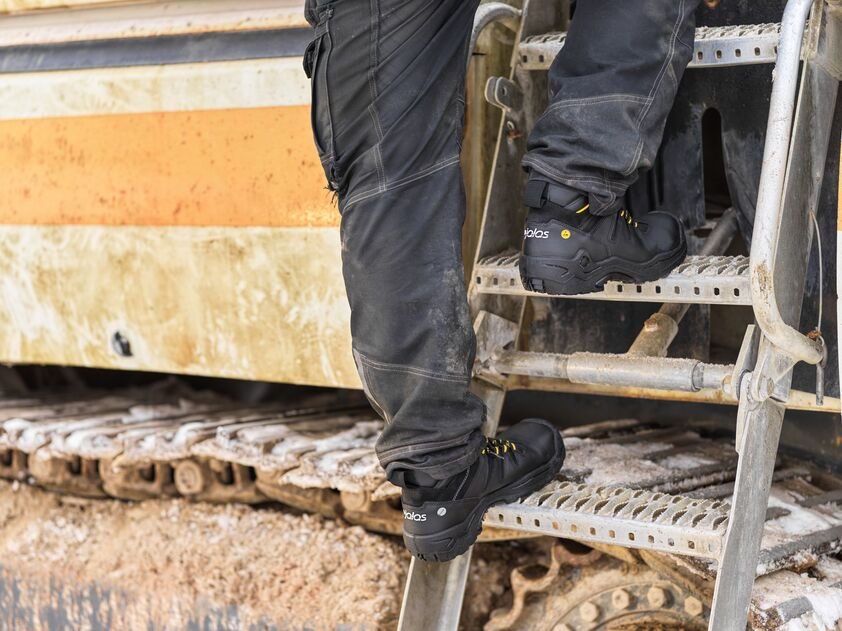
A slip-resistant outsole reduces, but doesn’t eliminate, the risk of slipping.
“It’s essential to remember that these ratings indicate potential performance; they aren’t a guarantee. Testing the shoes in the environment where they will be used provides a clearer picture of suitability.”
Conclusion: Choosing the Right Footwear for Your Environment
The EN ISO 20345:2022 update reflects a more holistic approach to safety standards, eliminating the misconception of a “best” slip resistance rating and promoting a focus on the actual needs of the workplace. With slip resistance now a foundational requirement, workers and employers can select footwear with confidence while understanding that some conditions may still require additional trials.
Sandra’s final advice?
“Stay proactive in safety equipment choices. Opt for shoes with slip resistance ratings that align with your specific work environment and, whenever possible, test them on-site to ensure they provide the protection you need.”

Discover JALAS®
JALAS® Work & Safety Shoes are engineered for the ultimate in slip resistance, comfort, and protection. Since 1916, JALAS® has upheld a commitment to quality, with all products designed, developed, and crafted in Jokipii, Finland. Discover our range of safety shoes, boots, and sandals—each built to keep you safe on the job without compromising comfort.