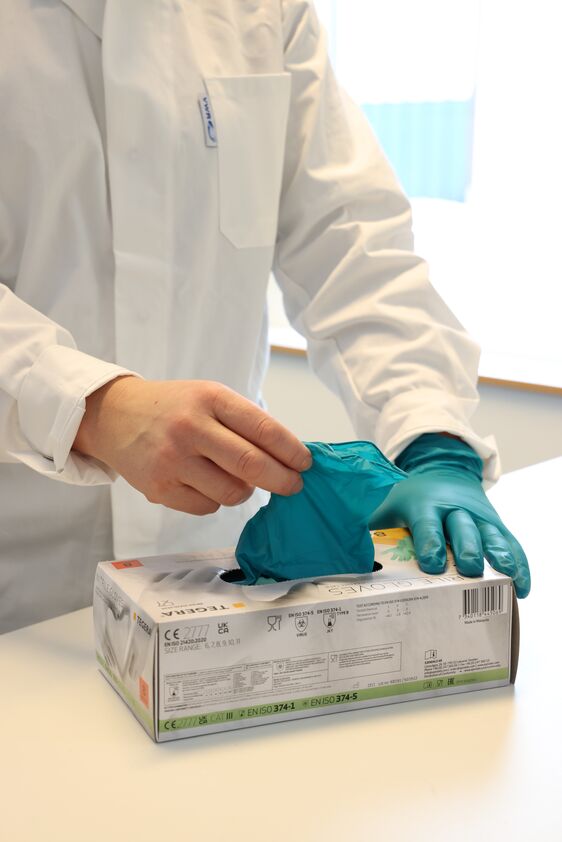
Que signifie exactement le terme « biodégradable » lorsqu'il s’applique aux gants en nitrile ?
Ces dernières années, un nombre croissant de gants en nitrile ont été commercialisés comme « biodégradables », souvent avec des références à des « additifs organiques » qui aident le matériau à se décomposer plus rapidement. Mais que signifie réellement « biodégradable » dans ce contexte ? Et peut-on vraiment considérer le nitrile comme tel ?

Chez Ejendals, nous croyons en une communication honnête et en un développement de produits fondé sur la science. Cela signifie laisser de côté le superflu pour vous aider à prendre des décisions éclairées concernant les gants de protection auxquels vous faites confiance chaque jour.
« Nous croyons en la transparence. Si vous portez des gants de protection TEGERA, vous devez savoir exactement quelles affirmations sont scientifiquement fondées et lesquelles ne le sont pas », explique Carina Hemstrand, responsable de l'équipe Gestion des produits chez Ejendals.
How Ejendals Is Reducing Environmental Impact
Even though nitrile isn’t biodegradable, we’re taking into account the environmental impact across the product life cycle – from raw materials to end-of-life.
- Conducting life-cycle assessments (LCAs) to identify the most impactful materials and process stages in glove production.
- Improving energy and resource efficiency in manufacturing and across facilities by transitioning to renewable energy and reducing reliance on fossil fuels.
- Exploring ways to increase circularity through responsible disposal such as recycling when feasible or burning for energy recovery.
Why It Matters
In an era of rising environmental claims, clear and honest communication is key. When you choose TEGERA by Ejendals, you're not just choosing hand protection – you're choosing a company committed to scientific integrity, product responsibility, and a long-term view of planetary health.
Find the right glove for your work environment
"Work safer with TEGERA CHEMFORCE – view the full collection now."
Carina Hemstrand - Team Manager, Chemical & Disposable Gloves at Ejendals
"Discover More About How Ejendals Works with Sustainable Safety"
Céline Montanari - Product Sustainability Lead at Ejendals.
Biodegradable vs. Degradable – What’s the Difference?
These two terms are often confused, but they are not the same. The reality is more complex.
Degradable means a material breaks down physically into smaller pieces over time (often into microplastics).
Biodegradable refers to a substance that can be broken down naturally by microorganisms into water, carbon dioxide, methane, and biomass – without leaving harmful residues. This decomposition can be anaerobic (without oxygen) or aerobic (with oxygen), and therefore, biodegradation depends on the environmental conditions – whether it is in soil, water, industrial composting facilities, or landfills. The biodegradation of biodegradable polymers involves chemical decomposition through the enzymatic work of microorganisms, leading to changes in chemical composition, mechanical and structural properties, and forming environmentally friendly materials such as methane, water, biomass, and carbon dioxide.
While nitrile can degrade, it does not 100% biodegrade – regardless of any additives.
“Sustainability in PPE presents a challenge, and solutions should be carefully analyzed to ensure a positive impact on the environment. Measurable progress can be achieved, particularly in manufacturing and material sourcing,” says Céline Montanari, Product Sustainability Lead at Ejendals.
Partially degradable nitrile gloves not only contribute to increasing microplastics in our soils and waters, but also to contamination when the gloves are discarded in nature or landfills.