


Impronta ambientale
La missione di Ejendals è sempre stata proteggere mani e piedi e farlo in modo responsabile. Quantificare l’impronta ambientale derivante dai nostri prodotti è un passo naturale per estendere tale responsabilità al pianeta.

La valutazione del ciclo di vita come base dei nostri calcoli ambientali
L’impronta ambientale dei nostri prodotti è calcolata utilizzando la metodologia Life Cycle Assessment (LCA), che assicura trasparenza circa l’impatto di ciascun prodotto sull’ambiente durante il suo ciclo di vita.
Applicando i principi LCA allo sviluppo dei nostri prodotti e comprendendo dove si verificano le emissioni, possiamo implementare pratiche di ecodesign per fare scelte di progettazione più intelligenti, utilizzare materiali più sostenibili e adottare processi efficienti dal punto di vista energetico. Ciò contribuisce a ridurre le emissioni all’interno delle nostre attività e della nostra catena di fornitura, supportando i nostri ambiziosi obietttivi climatici e consentendo ai nostri clienti di raggiungere i loro obiettivi di sostenibilità.
Si tratta di un passo naturale nel nostro impegno per un futuro più sicuro e sostenibile, in cui la protezione si estende oltre il luogo di lavoro al pianeta che tutti condividiamo.
Ejendals Product Environmental Footprint
Download our whitepaper
It explains how we calculate product environmental impact, including what a Life Cycle Assessment is, how Product Environmental Footprints and Product Carbon Footprints are defined, and the methodology we use to assess environmental impact — transparent, precise, and continuously evolving.
COMBINED PRODUCT ENVIRONMENTAL REPORT
download our combined report
The Ejendals Combined Product Environmental Report presents life cycle–based carbon footprint calculations for selected products. Using recognised methodologies, the report provides transparent environmental data to support informed and responsible choices.
How we calculate environmental footprints
What is the carbon footprint?
A product’s carbon footprint represents the total greenhouse gas (GHG) emissions generated throughout its life cycle, measured as carbon dioxide equivalents (CO₂e).
How do you conduct carbon footprint calculations?
We use the Life Cycle Assessment (LCA) method, an internationally standardised methodology used to assess the environmental impacts of products, including the carbon footprint.
What is the scope of your carbon footprint calculations?
We use a cradle-to-grave LCA approach, covering all stages from raw material extraction and production to transport, use, and end-of-life treatment.
Which standards do you follow?
ISO 14040/14044 and Product Category Rules (PCR) guidelines for LCA, and ISO 14067 for product carbon footprints.
Do you include packaging and transportation?
Yes, both are included in our life cycle assessments.
Can results be compared with other brands?
Direct comparisons can be misleading due to differences in scope, data sources, and methodologies. To ensure transparency, we always disclose the calculation scope, and provide both cradle-to-gate and cradle-to-grave results.
Where can I find available results for Ejendals products?
The carbon footprints of our products are continuously being calculated. All available results are published in our Combined Product Environmental Report.
Example of environmental impact calculation
The image shows the carbon footprint per pair and contribution breakdown for two TEGERA glove models (size 10).
For comparison, the approximate carbon footprint of common everyday products is shown below, expressed as kilograms of carbon dioxide equivalents (kg CO₂e).
| Example Product | Approximate carbon footprint |
|---|---|
| 33 cl PET bottle | Carbon footprint:0.08 kg CO₂e |
| Electric car | Carbon footprint: 60,000 kg CO₂e |
| Smartphone | Carbon footprint: 70 kg CO₂e |
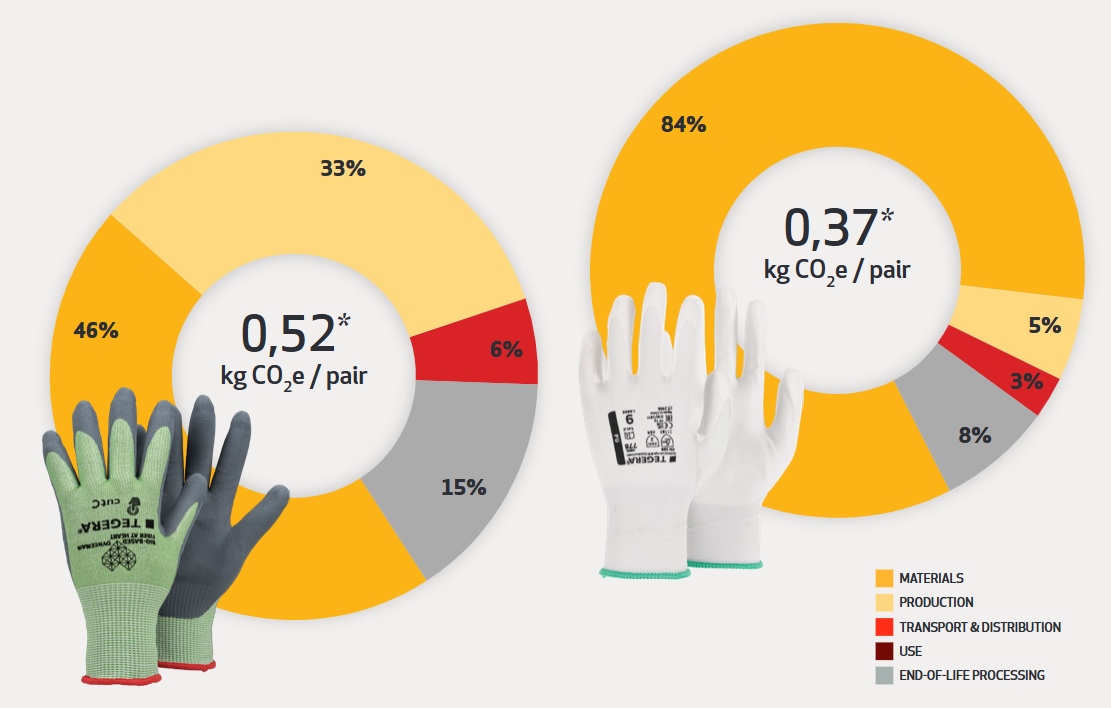
*LCA scope: cradle-to-grave, assumed to be distributed to an average regional customer in Sweden. Calculation method: IPCC 2021 (GWP100) following ISO 14067. Calculation date: 10/2025.

Ejendals - Sustainable Safety
Product Sustainability
At Ejendals, we design TEGERA safety gloves and JALAS safety footwear that protect not only the people who wear them, but also the world they work in. Product sustainability is our commitment to developing PPE with a smaller environmental footprint throughout its entire lifecycle—from material selection and manufacturing to durability, reuse, and end-of-life management.