


Slipweerstandsclassificaties van veiligheidsschoenen
Veiligheidsnormen zijn steeds in ontwikkeling, en dit heeft zijn weerslag op de producten waarop we vertrouwen. We spraken met Sandra Dahlström, nalevingsexpert bij Ejendals, over de nieuwste updates betreffende slipweerstand in de norm EN ISO 20345:2022. Ze laat haar licht schijnen op de betekenis van deze veranderingen voor werknemers, die op zoek zijn naar een betrouwbare bescherming op uiteenlopende ondergronden.

Belangrijke updates in de nieuwe norm EN ISO 20345:2022
Sandra begint met uit te leggen dat de veranderingen in EN ISO 20345:2022 het gemakkelijker maken om te begrijpen hoe veiligheidsschoeisel presteert in verschillende omstandigheden, met name op het gebied van slipbestendigheid en perforatiebescherming.
Perforatiebescherming
De norm definieert drie soorten aanduidingen, waarbij onderscheid wordt gemaakt tussen metalen en niet-metalen opties:
P: Stalen inlegzool, getest met een spijker met een diameter van 4,5 mm.
PL: Niet-metalen inlegzool, eveneens getest met een 4,5 mm spijker.
PS: Niet-metalen inlegzool, getest met een kleinere spijker met een diameter van 3 mm.
Laddergrip
Dit is nu een niet-verplichte test, met enige flexibiliteit afhankelijk van het beoogde gebruik van het schoeisel.
Slipweerstand
Is er echt een beoordeling voor de “beste”?
Een van de belangrijkste zaken waarover Sandra vertelt, is dat er geen beoordeling is voor de “beste” slipweerstand. “Deze normen waren nooit bedoeld om een beoordeling van goed, beter en beste te creëren,” legt Sandra uit. In plaats daarvan is de beoordeling sterk afhankelijk van de specifieke omstandigheden op de werkplek.
Voorheen werd slipweerstand in de EN ISO 20345:2011-norm ingedeeld in drie categorieën:
SRA: Getest op een keramische vloer met een zeepoplossing.
SRB: Getest op een stalen vloer met glycerine.
SRC: Voldoet aan de vereisten van zowel SRA als SRB.
Sandra Dahlström
Product Compliance Manager at Ejendals
Discover More about EN ISO 20345:2022
Want to know what else is new in the EN ISO 20345:2022 standard? Find out here.
Under this older standard, SRC might seem like the “best” option, but as Sandra points out, it’s more complex than that.
“An outsole that excels in SRA conditions might not be as effective in SRB conditions, and vice versa. To meet both requirements, some compromises might be made in the design, so SRC approval doesn’t necessarily mean the highest slip resistance in every environment.”
What’s New in EN ISO 20345:2022?
The new 2022 standard has eliminated the SRA, SRB, and SRC classifications to avoid confusion. Instead, slip resistance testing is now a basic requirement, meaning all safety footwear must be tested on ceramic floors with soap solutions without needing a specific marking. However, there is an optional SR test, indicating that the footwear has been tested on a ceramic floor with glycerin, suited for more oily surfaces.
- Mandatory Test (no marking) - Conducted on ceramic floors with soap solution.
- Optional SR Test - Conducted on ceramic floors with glycerin, designed to evaluate the footwear’s performance on oily surfaces.
By incorporating slip resistance as a baseline requirement, the updated standard emphasizes that all certified safety shoes meet a minimum threshold without labeling, making the selection process more straightforward.

Real-World Application: Testing Beyond the Laboratory
Sandra emphasized that while lab-tested slip resistance ratings are helpful, they don’t account for the diverse and unpredictable conditions workers may encounter. “No set of laboratory tests can fully model the wide range of real-life walking surfaces,” she noted. This is why Sandra recommends conducting footwear field trials in the actual workplace environment to assess performance accurately.
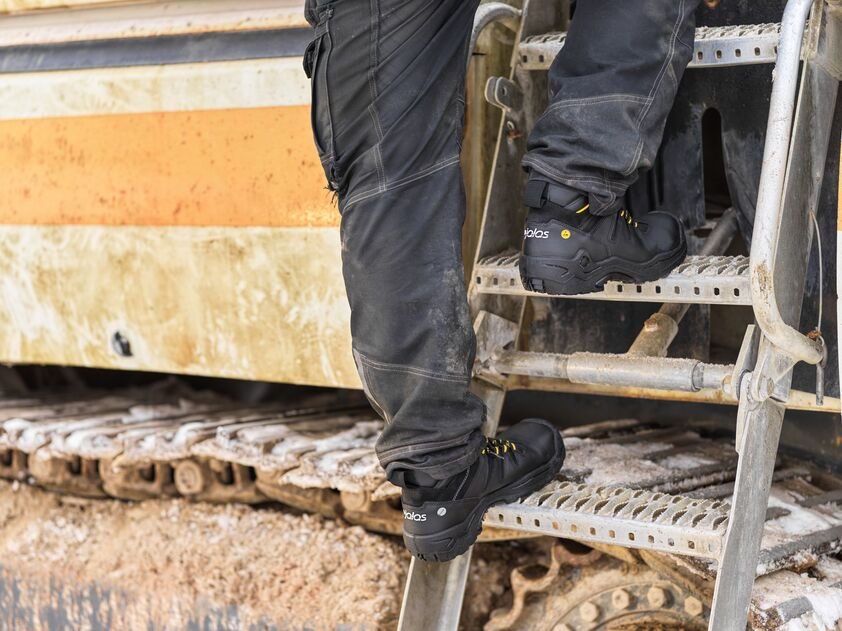
A slip-resistant outsole reduces, but doesn’t eliminate, the risk of slipping.
“It’s essential to remember that these ratings indicate potential performance; they aren’t a guarantee. Testing the shoes in the environment where they will be used provides a clearer picture of suitability.”
Conclusion: Choosing the Right Footwear for Your Environment
The EN ISO 20345:2022 update reflects a more holistic approach to safety standards, eliminating the misconception of a “best” slip resistance rating and promoting a focus on the actual needs of the workplace. With slip resistance now a foundational requirement, workers and employers can select footwear with confidence while understanding that some conditions may still require additional trials.
Sandra’s final advice?
“Stay proactive in safety equipment choices. Opt for shoes with slip resistance ratings that align with your specific work environment and, whenever possible, test them on-site to ensure they provide the protection you need.”

Discover JALAS®
JALAS® Work & Safety Shoes are engineered for the ultimate in slip resistance, comfort, and protection. Since 1916, JALAS® has upheld a commitment to quality, with all products designed, developed, and crafted in Jokipii, Finland. Discover our range of safety shoes, boots, and sandals—each built to keep you safe on the job without compromising comfort.