


EN 12477 Standard – Welding Protection in Safety Gloves
EN 12477 is the European standard that defines safety requirements for gloves used in welding and related processes. It ensures that gloves provide reliable protection against heat, sparks, and mechanical hazards while maintaining dexterity for handling tools and materials.
What Does EN 12477 Cover?
The EN 12477:2001+ A1:2005 standard describes how gloves should be constructed to protect against:
- Heat and flames
- Sparks and molten metal
- Mechanical risks such as abrasion and cuts
- Electrical resistance for arc welding
Which Standards Must Welding Gloves Be Tested According To?
- EN 388 (mechanical protection). Requirements included are Abrasion, Cut (coup), Tear and Puncture.
- EN 407 (thermal protection). Requirements included are Limited Flame spread, Contact heat, Covetive heat and Small splashes of metal.
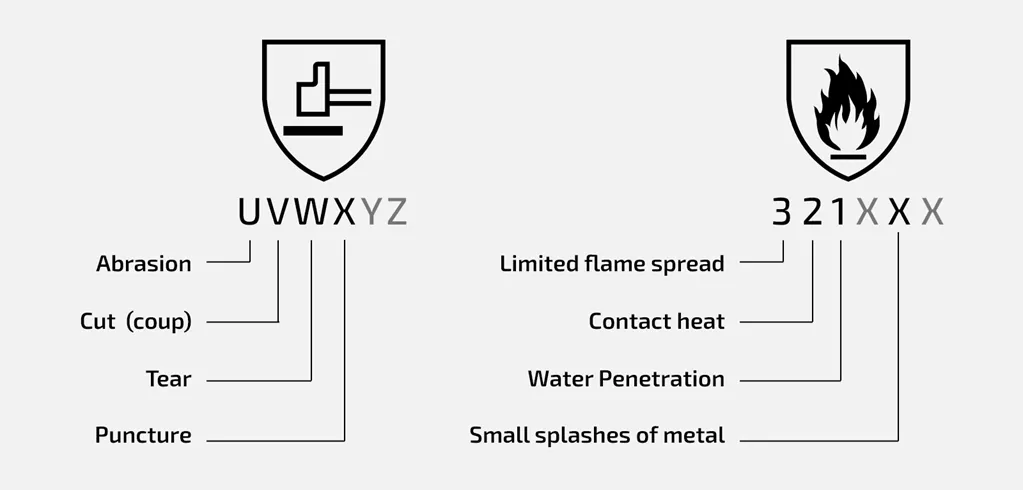
Requirements test values in relatoin to the EN 388 and EN 407 Standards.
Classification: Type A and Type B
Based on test results from EN 388 and EN 407, gloves are classified as:
- Type A – Higher resistance requirements to heat and mechanical risks, suitable for heavy welding tasks.
Lower flexibility and dexterity. - Type B – Greater flexibility and dexterity for precision welding (e.g., TIG welding).
Lower resistance requirements compared to Type A.
Dexterity of Welding Gloves
Dexterity is a key factor when choosing welding gloves because it affects how easily you can handle tools and materials. The EN 12477 standard defines how glove dexterity is tested and rated to ensure safety without compromising functionality.
What Determines Glove Dexterity?
Dexterity depends on:
- Material thickness – Thicker gloves offer more protection but reduce flexibility.
- Elasticity – More elastic materials allow better finger movement.
How Is Dexterity Tested?
The test measures how easily a wearer can pick up small steel pins from a flat surface:
- Four gloves are tested.
- The wearer must pick up the smallest pin three times within 30 seconds.
- Pins range from 5 mm to 11 mm in diameter – the smaller the pin, the higher the dexterity level.
- If no pin can be picked up, the level is 0.
Performance Levels for Welding Gloves
Dexterity levels are linked to pin size:
- Level 1: Larger pins (lower dexterity)
- Level 4: Smaller pins (higher dexterity)
For welding gloves:
- Type A: Lower dexterity, minimum Level 1
- Type B: Higher dexterity, minimum Level 4
This ensures that Type B gloves are suitable for tasks requiring precision, while Type A gloves prioritize protection for heavy-duty welding.
Design Requirements
Welding gloves should be longer than standard protective gloves to cover the wrist and part of the forearm. Sizes must correspond to the EN 12477 sizing table.
| Hand Size | 6 | 7 | 8 | 9 | 10 | 11 |
|---|---|---|---|---|---|---|
| Minimum length of glove (mm) | 300 | 310 | 320 | 330 | 340 | 350 |
Note: Gloves intended for arc welding must be tested for electrical vertical resistance according to EN 1149-2. Both Type A and Type B gloves must have a resistance of >10⁵ Ω.
Typical Applications
- MIG/MAG welding
- TIG welding
- Arc welding
- Plasma cutting
- Grinding and metal preparation
We are here to guide you
Wether you have questions about safety standards, our assortment or how to select the right product, don't hesitate to reach out to us.
Discover Our Welding Range
Welding Gloves by TEGERA
Engineered for welders who demand the best in safety and comfort.
Get more Knowledge
Explore All TEGERA Safety Standards
TEGERA safety gloves are developed to meet a wide range of certified standards—from cut and chemical protection to heat resistance and cold insulation. Explore how each standard contributes to safer work environments and helps keep workers protected across every task.