


Guida ai guanti resistenti alle sostanze chimiche TEGERA
Consulta la nostra guida sulla protezione chimica o contatta uno dei nostri rivenditori e ottieni assistenza per trovare i guanti adatti per proteggerti dalle miscele di prodotti chimici specifici che utilizzi.
Previeni l’esposizione alle sostanze chimiche usando i guanti di protezione giusti
Se utilizzi oli e sostanze chimiche senza proteggerti le mani, ti esponi al rischio di danni alla cute, oltre che al sistema nervoso e agli organi vitali. Inoltre, tali sostanze potrebbero causare irritazioni cutanee, ipersensibilità e danni da corrosione. Per scegliere i guanti giusti, utilizza sempre la nostra guida sulla protezione chimica o consulta il nostro personale di vendita.
Tutti i guanti di protezione chimica sono testati e approvati in conformità alla specifica EN 374, relativa ai rischi associati a sostanze chimiche e microorganismi. I guanti di protezione chimica sono monouso, quindi si utilizzano solo per un giorno e, talvolta, per periodi di tempo anche più brevi.
TROVA LA GIUSTA PROTEZIONE CHIMICA CON IL SUPPORTO DEI NOSTRI ESPERTI
Scegli l’opzione più adatta alla tua situazione.
Utilizza la Guida alla Protezione Chimica
Se le sostanze chimiche utilizzate e l’ambiente di lavoro sono noti, la nostra Guida alla Protezione Chimica può aiutarti a individuare i guanti più adatti per le applicazioni più comuni.
Questa opzione è adatta se:
- Sai quali sostanze chimiche vengono utilizzate
- Sono disponibili le Schede di Dati di Sicurezza (SDS)
- Il processo di lavoro e le condizioni di esposizione sono chiaramente definiti
Richiedi una valutazione della protezione chimica
Se la tua applicazione è più complessa o richiede una valutazione specialistica, i nostri esperti possono analizzare le tue condizioni specifiche e consigliarti i guanti più adatti.
Questa opzione è consigliata se:
- Vengono utilizzate contemporaneamente più sostanze chimiche
- Le condizioni di esposizione sono complesse o incerte
- Non sei sicuro di quale soluzione di guanti sia la più adatta
Cosa ci serve da te
- Scarica e compila il modulo Excel per la valutazione della protezione chimica.
- Allega le Schede di Dati di Sicurezza (SDS) pertinenti.
- Invia la documentazione al team Customer Service competente:
- Svezia, Norvegia e Danimarca: Invia un’e-mail al Nordic Customer Service
- Tutti gli altri mercati: Invia un’e-mail al Customer Service
Per domande generali sulla protezione chimica, contatta il Customer Service tramite il nostro modulo di contatto.
BREAK-THROUGH-TIMES (BTT) FOR A SELECTION OF COMMON CHEMICALS
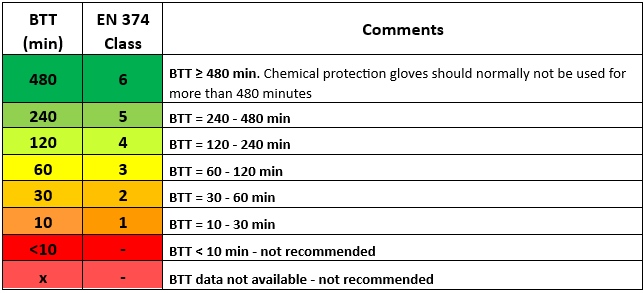
Break-through-time (BTT) is the time when a chemical is considered to have permeated (passed through) a material. It depends primarily on the material and secondarily on the thickness (and other factors). All data refer to full contact with the chemicals at room temperature, and need to be adjusted for actual conditions and additional risks.
The BTT data in this chemical protection guide originate from combined data from laboratory tests and our internal database. The BTT values are calculated from best-fit to experimental points and rounded downwards to closest EN374 Class (and two additional lower levels (0 – 5 min) that might be useful when selecting gloves for work operations of very short duration).
THINGS TO CONSIDER WHEN CHOOSING CHEMICAL PROTECTION GLOVES
- A glove that gives good protection against a certain individual chemical may give very poor protection against others or a mixture of chemicals.
- As a rule, chemical protection gloves are intended for single-day use. They must not be re-used.
- A used glove is chemically contaminated and there is a risk that the skin will be exposed to harmful substances when it is handled.
- Higher temperatures shorten the time it takes for the chemical to break through.
- Thicker materials generally mean longer breakthrough times (BTT).
- At Ejendals, for gloves consisting of multiple layers (liner etc), we denote the effective thickness of the chemical protection layer with an asterisk (*). It is this thickness we use in our estimations of BTT for a certain combination of glove model and chemical.
- Once a chemical has been absorbed, it continues to break through (permeate) the protective glove.
- Permeation through a protective glove takes place at the molecular level and is therefore not visible to the naked eye.
- Even the best gloves lose their protective properties if they are mechanically damaged or if the chemical has broken through the material.
- Strongly corrosive chemicals can destroy the glove material by breaking it down before the specified breakthrough time.
WHAT IS WHAT?
- PERMEATION is a process whereby the chemical is absorbed into and passes through the glove material at a molecular level.
- PENETRATION involves the chemical moving through pinholes and other imperfections in the glove material.
- DEGRADATION is when the glove material’s physical resistance deteriorates under the influence of a chemical.
MIXING CHEMICALS CAN HAVE UNEXPECTED RESULTS
Two chemicals with known characteristics can produce unexpected effects when mixed. Since the number of chemicals marketed is huge, it is virtually impossible to test all conceivable combinations of them. Models do exist for estimating combined effects on the basis of what is known about the component chemicals. However, they presuppose that data is available and that the various chemicals involved have the same mechanisms of action. This means that the models can only be used for groups of chemicals that act in a similar way – not for the complex mix of chemicals that we are exposed to in reality.

WARRANTY LIMITATIONS AND DISCLAIMER USE
This information is provided solely as a convenience to help you evaluate our gloves in the end-users particular application. The information provided reflects performance of glove materials under carefully controlled conditions. Ejendals AB assumes no obligation or liability in connection with glove guidance information. It is the responsibility of the purchaser and/or user to determine the level of toxicity of the materials to be handled and to select the proper glove suitable for a particular application.

TEGERA CHEMICAL PROTECTION GLOVES
Explore our range of Chemical Protection Gloves.

EJENDALS CHEMICAL PERMEATION LAB
Ejendals has invested in a first-class laboratory to serve you better when providing you with a safety glove that protects you from the hazardous effects of challenge chemicals.