


TEGERA'nın Kimyasal Dirençli Eldivenler Rehberi
Kimyasal koruma rehberimizi kullanın veya satıcılarımızdan biriyle iletişime geçip ilgili kimyasal karışıma karşı uygun bir eldiven bulma konusunda yardım alın.
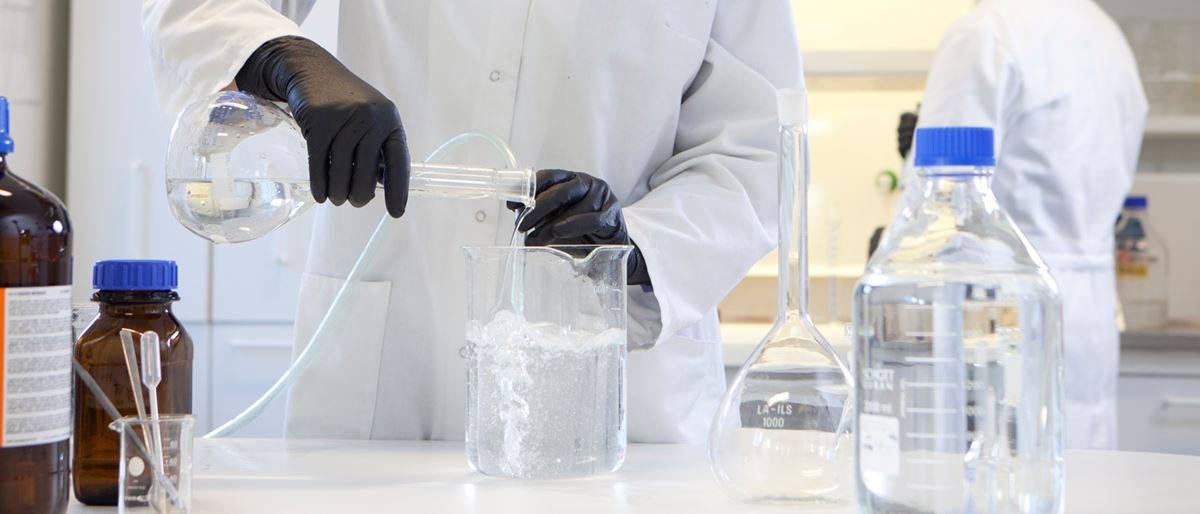
Kimyasal Maruz Kalmanı Önlemek: Doğru Koruyucu Eldivenleri Kullanın
Ellerinizi korumadan yağ ve kimyasalları ele alırsanız, sadece cilt hasarı değil, sinir sisteminiz ve hayati organlarınız için de risk altınız olur. Ayrıca kimyasallar nedeniyle cilt tahrişi, aşırı hassasiyet ve korozyon hasarı geliştirme riski taşır. Eldiven seçerken her zaman kimyasal koruma rehberimizi kullanın veya satıcılarımızla görüşün.
Tüm Ejendals kimyasal eldivenleri EN 374, kimyasal ve mikroorganizma risklerine göre test edilip onaylanmıştır. Kimyasal koruma eldivenleri tek günlük kullanım için tasarlanmıştır ve bazen daha kısa süreler için de geçerlidir.
UZMAN REHBERLIĞIYLE DOĞRU KIMYASAL KORUMAYI ALIN
Durumunuza en uygun seçeneği seçin.
Kimyasal Koruma Rehberini Kullanın
Kimyasallar ve çalışma ortamı biliniyorsa, Kimyasal Koruma Rehberimiz yaygın uygulamalar için uygun eldivenleri belirlemenize yardımcı olabilir.
Bu seçenek şu durumlarda uygundur:
- Hangi kimyasalların işlendiğini biliyorsun
- Güvenlik Veri Formları (SDS) mevcuttur
- Çalışma süreci ve maruz kalma koşulları iyi tanımlanmıştır
Kimyasal Koruma Değerlendirmesi Talep Edin
Başvurunuz daha karmaşıksa veya uzman değerlendirmesi gerektiriyorsa, uzmanlarımız özel durumlarınızı değerlendirebilir ve uygun eldivenler önerebilir.
Bu seçenek şu durumlarda önerilir:
- Birden fazla kimyasal birlikte kullanılır
- Maruz kalma koşulları karmaşık veya belirsizdir
- Hangi eldiven çözümünün uygun olduğundan emin değilsiniz
Senden ihtiyacımız olanlar
- Kimyasal Koruma Excel Formunu indirin ve doldurun
- İlgili Güvenlik Bilgi Formlarını (SDS) ekleyin
- Belgeleri ilgili Müşteri Hizmetleri ekibine gönderin:
- İsveç, Norveç ve Danimarka: Nordic Müşteri Hizmetleri'ne e-posta gönderin
- Diğer tüm pazarlar: E-posta Müşteri Hizmetleri
Kimyasal koruma ile ilgili genel sorularınız için lütfen iletişim formumuz üzerinden Müşteri Hizmetleri ile iletişime geçin.
BREAK-THROUGH-TIMES (BTT) FOR A SELECTION OF COMMON CHEMICALS
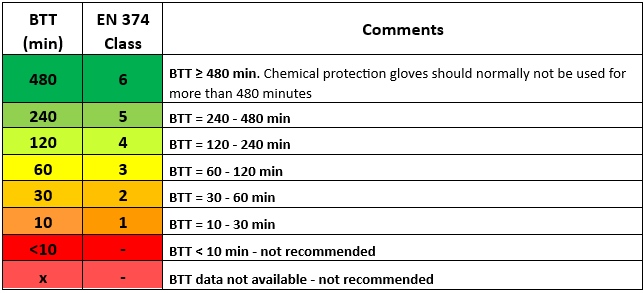
Break-through-time (BTT) is the time when a chemical is considered to have permeated (passed through) a material. It depends primarily on the material and secondarily on the thickness (and other factors). All data refer to full contact with the chemicals at room temperature, and need to be adjusted for actual conditions and additional risks.
The BTT data in this chemical protection guide originate from combined data from laboratory tests and our internal database. The BTT values are calculated from best-fit to experimental points and rounded downwards to closest EN374 Class (and two additional lower levels (0 – 5 min) that might be useful when selecting gloves for work operations of very short duration).
THINGS TO CONSIDER WHEN CHOOSING CHEMICAL PROTECTION GLOVES
- A glove that gives good protection against a certain individual chemical may give very poor protection against others or a mixture of chemicals.
- As a rule, chemical protection gloves are intended for single-day use. They must not be re-used.
- A used glove is chemically contaminated and there is a risk that the skin will be exposed to harmful substances when it is handled.
- Higher temperatures shorten the time it takes for the chemical to break through.
- Thicker materials generally mean longer breakthrough times (BTT).
- At Ejendals, for gloves consisting of multiple layers (liner etc), we denote the effective thickness of the chemical protection layer with an asterisk (*). It is this thickness we use in our estimations of BTT for a certain combination of glove model and chemical.
- Once a chemical has been absorbed, it continues to break through (permeate) the protective glove.
- Permeation through a protective glove takes place at the molecular level and is therefore not visible to the naked eye.
- Even the best gloves lose their protective properties if they are mechanically damaged or if the chemical has broken through the material.
- Strongly corrosive chemicals can destroy the glove material by breaking it down before the specified breakthrough time.
WHAT IS WHAT?
- PERMEATION is a process whereby the chemical is absorbed into and passes through the glove material at a molecular level.
- PENETRATION involves the chemical moving through pinholes and other imperfections in the glove material.
- DEGRADATION is when the glove material’s physical resistance deteriorates under the influence of a chemical.
MIXING CHEMICALS CAN HAVE UNEXPECTED RESULTS
Two chemicals with known characteristics can produce unexpected effects when mixed. Since the number of chemicals marketed is huge, it is virtually impossible to test all conceivable combinations of them. Models do exist for estimating combined effects on the basis of what is known about the component chemicals. However, they presuppose that data is available and that the various chemicals involved have the same mechanisms of action. This means that the models can only be used for groups of chemicals that act in a similar way – not for the complex mix of chemicals that we are exposed to in reality.

WARRANTY LIMITATIONS AND DISCLAIMER USE
This information is provided solely as a convenience to help you evaluate our gloves in the end-users particular application. The information provided reflects performance of glove materials under carefully controlled conditions. Ejendals AB assumes no obligation or liability in connection with glove guidance information. It is the responsibility of the purchaser and/or user to determine the level of toxicity of the materials to be handled and to select the proper glove suitable for a particular application.

TEGERA CHEMICAL PROTECTION GLOVES
Explore our range of Chemical Protection Gloves.

EJENDALS CHEMICAL PERMEATION LAB
Ejendals has invested in a first-class laboratory to serve you better when providing you with a safety glove that protects you from the hazardous effects of challenge chemicals.