


TEGERAS guide till kemikalieskyddshandskar
Använd vår kemikalieskyddsguide eller kontakta en av våra säljare för att hitta en handske som ger rätt skydd mot en specifik kemisk blandning.

Förhindra kemisk exponering, Använd rätt skyddshandskar
Om du arbetar med olja och kemikalier utan att skydda händerna utsätter du inte bara huden för risker. Även nervsystemet och inre organ riskerar att skadas. Det kan även orsaka irritation på huden, överkänslighet och frätskador. Använd alltid vår kemikalieskyddsguide eller konsultera en av våra säljare när du ska välja handske.
Alla Ejendals kemikaliehandskar är testade och godkända enligt EN 374 vad gäller risker med mikroorganismer och/eller kemikalier. Kemikalieskyddshandskar är avsedda att användas under endast en dag, ibland under ännu kortare tid.
HITTA RÄTT KEMSKYDD MED VÄGLEDNING FRÅN VÅRA EXPERTER
Välj det alternativ som passar din situation bäst.
Använd Kemskyddsguiden
Om de kemikalier som används och arbetsmiljön är kända kan vår Kemskyddsguide hjälpa dig att identifiera lämpliga handskar för vanliga användningsområden.
Det här alternativet passar om:
- Du vet vilka kemikalier som hanteras
- Säkerhetsdatablad (SDB) finns tillgängliga
- Arbetsprocessen och exponeringsförhållandena är tydligt definierade
Få en kemskyddsbedömning
Om din applikation är mer komplex eller kräver en expertbedömning kan våra specialister utvärdera dina specifika förhållanden och rekommendera lämpliga handskar.
Det här alternativet rekommenderas om:
- Flera kemikalier används tillsammans
- Exponeringsförhållandena är komplexa eller osäkra
- Du är osäker på vilken handsklösning som är mest lämplig
Det här behöver vi från dig
- Ladda ner och fyll i Excel-formuläret för kemskyddsbedömning.
- Bifoga relevanta säkerhetsdatablad (SDB).
- Skicka dokumenten till rätt Customer Service-team:
- Sverige, Norge och Danmark: E-posta Nordic Customer Service
- Alla andra marknader: E-posta Customer Service
För allmänna frågor om kemskydd, kontakta Customer Service via vårt kontaktformulär.
BREAK-THROUGH-TIMES (BTT) FOR A SELECTION OF COMMON CHEMICALS
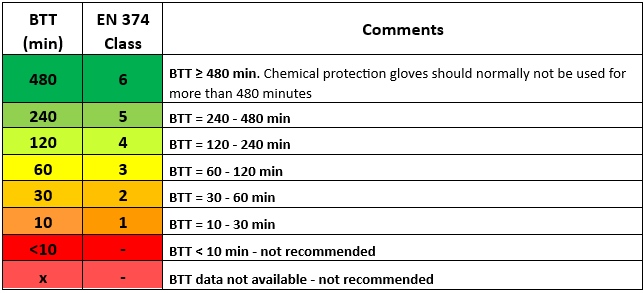
Break-through-time (BTT) is the time when a chemical is considered to have permeated (passed through) a material. It depends primarily on the material and secondarily on the thickness (and other factors). All data refer to full contact with the chemicals at room temperature, and need to be adjusted for actual conditions and additional risks.
The BTT data in this chemical protection guide originate from combined data from laboratory tests and our internal database. The BTT values are calculated from best-fit to experimental points and rounded downwards to closest EN374 Class (and two additional lower levels (0 – 5 min) that might be useful when selecting gloves for work operations of very short duration).
THINGS TO CONSIDER WHEN CHOOSING CHEMICAL PROTECTION GLOVES
- A glove that gives good protection against a certain individual chemical may give very poor protection against others or a mixture of chemicals.
- As a rule, chemical protection gloves are intended for single-day use. They must not be re-used.
- A used glove is chemically contaminated and there is a risk that the skin will be exposed to harmful substances when it is handled.
- Higher temperatures shorten the time it takes for the chemical to break through.
- Thicker materials generally mean longer breakthrough times (BTT).
- At Ejendals, for gloves consisting of multiple layers (liner etc), we denote the effective thickness of the chemical protection layer with an asterisk (*). It is this thickness we use in our estimations of BTT for a certain combination of glove model and chemical.
- Once a chemical has been absorbed, it continues to break through (permeate) the protective glove.
- Permeation through a protective glove takes place at the molecular level and is therefore not visible to the naked eye.
- Even the best gloves lose their protective properties if they are mechanically damaged or if the chemical has broken through the material.
- Strongly corrosive chemicals can destroy the glove material by breaking it down before the specified breakthrough time.
WHAT IS WHAT?
- PERMEATION is a process whereby the chemical is absorbed into and passes through the glove material at a molecular level.
- PENETRATION involves the chemical moving through pinholes and other imperfections in the glove material.
- DEGRADATION is when the glove material’s physical resistance deteriorates under the influence of a chemical.
MIXING CHEMICALS CAN HAVE UNEXPECTED RESULTS
Two chemicals with known characteristics can produce unexpected effects when mixed. Since the number of chemicals marketed is huge, it is virtually impossible to test all conceivable combinations of them. Models do exist for estimating combined effects on the basis of what is known about the component chemicals. However, they presuppose that data is available and that the various chemicals involved have the same mechanisms of action. This means that the models can only be used for groups of chemicals that act in a similar way – not for the complex mix of chemicals that we are exposed to in reality.

WARRANTY LIMITATIONS AND DISCLAIMER USE
This information is provided solely as a convenience to help you evaluate our gloves in the end-users particular application. The information provided reflects performance of glove materials under carefully controlled conditions. Ejendals AB assumes no obligation or liability in connection with glove guidance information. It is the responsibility of the purchaser and/or user to determine the level of toxicity of the materials to be handled and to select the proper glove suitable for a particular application.

TEGERA CHEMICAL PROTECTION GLOVES
Explore our range of Chemical Protection Gloves.

EJENDALS CHEMICAL PERMEATION LAB
Ejendals has invested in a first-class laboratory to serve you better when providing you with a safety glove that protects you from the hazardous effects of challenge chemicals.